Building BioTone’s biometric authentication platform from proof of concept to product
An ongoing technology partnership building BioTone’s biometric authentication platform across mobile enrollment, verification, APIs, and administration.
BioTone is developing a multi-signal biometric authentication platform. Orpheus is its technology and development partner across product engineering, mobile, APIs, administration, developer tools, and the public website.
Orpheus joined BioTone in February 2026 to turn an early iOS and Android proof of concept into a connected authentication product. Since April, the engagement has expanded across product strategy, mobile engineering, backend services, an OpenID Connect broker, enterprise administration, a developer portal, deployment tooling, brand, and the public website.
The program combines deployed services, evaluation apps, and work still in development. This case labels those states separately: the API, enterprise console, developer portal, and website are deployed; iOS is in TestFlight beta; Android remains in internal testing; SDKs and additional enterprise sign-in integrations are in development.
From an early proof of concept to a connected product platform
BioTone is developing authentication that can evaluate several biometric, liveness, device, and contextual signals together instead of relying on a single check. Orpheus is BioTone’s technology and development partner.
The engagement began in February 2026 with an iOS and Android proof of concept. Production MVP development started in April, and the work has grown into a connected set of mobile, API, administration, developer, and public web experiences.
Guided enrollment and verification on the phone
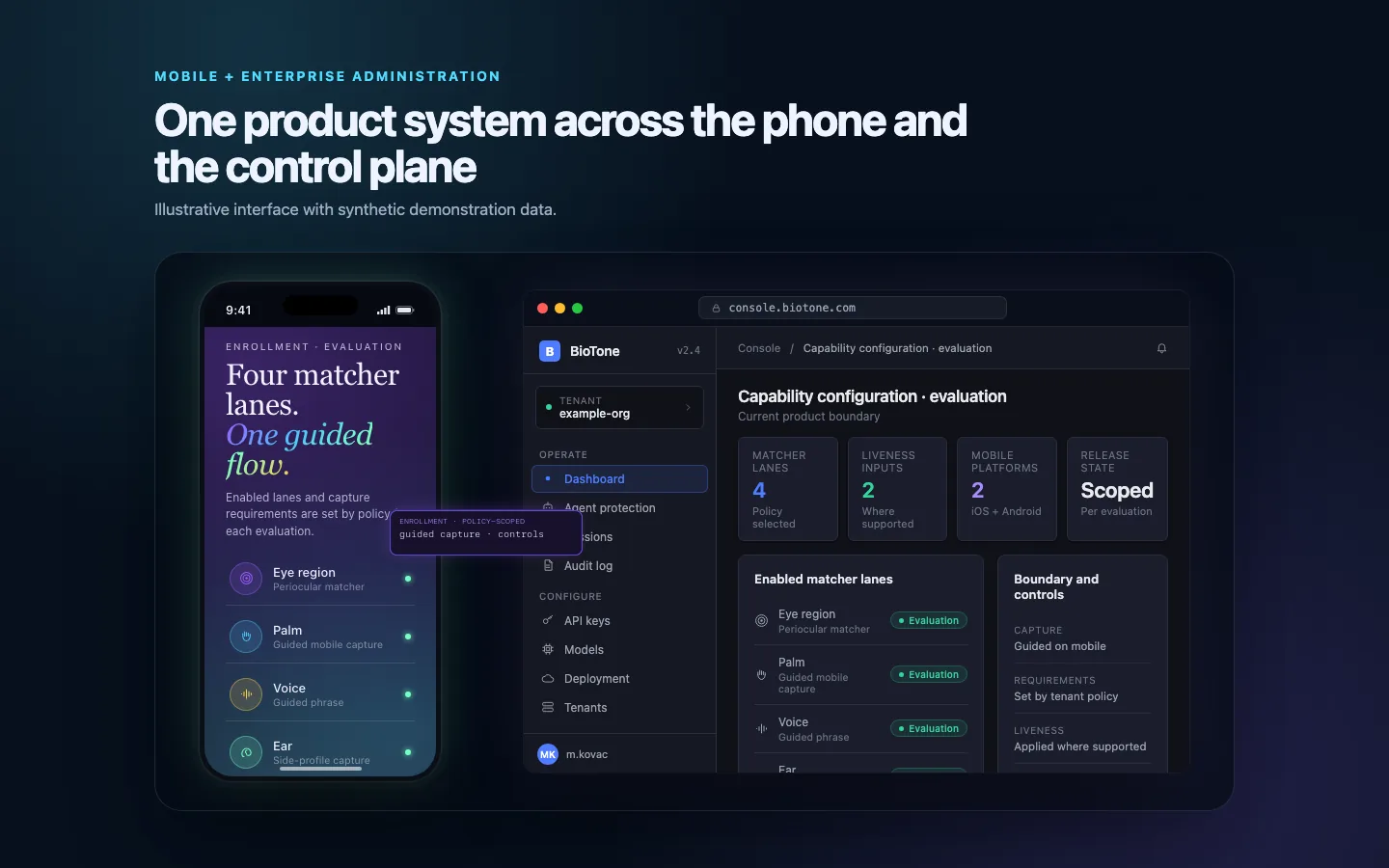
The cross-platform app guides people through enrollment and verification using supported face, palm, ear, voice, and eye-region capture, together with liveness checks and device context. Signal scores can be combined into one policy-based decision.
Matching runs on the device, and enrolled templates are stored encrypted on the phone. The iOS app is in beta through TestFlight, while Android builds remain in internal testing. The interface composition below uses synthetic demonstration data and does not depict a customer tenant.
A phone-based check connected to a brokered session
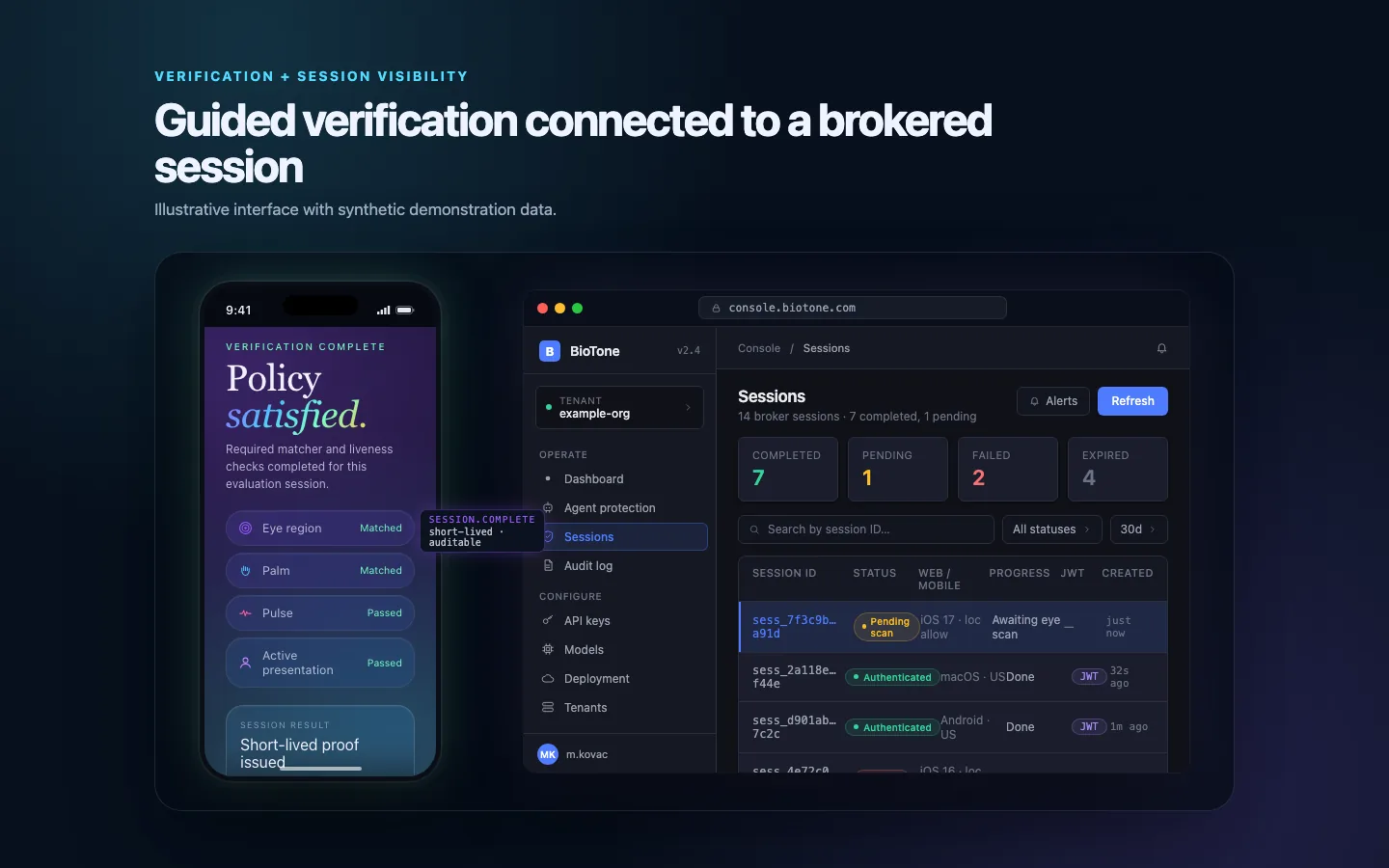
A web or desktop sign-in can present a QR code, the person completes verification on the phone, and the application receives a short-lived signed token through an OpenID Connect broker. The same foundation supports step-up verification before sensitive actions.
The administration experience gives an authorized team visibility into session state and progress. Enterprise identity-provider integrations are still in development. The composition below is explicitly illustrative and uses synthetic demonstration data.
Backend services and administration for a multi-tenant product
A Python and FastAPI backend supports enrollment and verification sessions, tenant boundaries, and the services used by the mobile and web experiences. BioTone’s enterprise console supports customer administration, while a separate control plane supports BioTone’s own operations.
The API, enterprise console, developer portal, and public website are deployed. This case does not make claims about biometric accuracy, certification, or medical use.
A deployed portal and API, with repeatable deployment paths
The developer portal and API were deployed in April 2026, giving integrators documentation and a server-side verification path. Software development kits remain in development and are not presented here as published packages.
Orpheus also built BioTone’s public website and the deployment automation behind the platform: scripted cloud deployment for its services and a self-hosted deployment kit based on Docker Compose. This is a defined deployment toolkit rather than a claim of general infrastructure-as-code or customer-hosted availability.

A clearer identity for an advanced product
As the platform matured, the engagement expanded into BioTone’s identity and public presentation. The current brand system includes the segmented signal mark, the Human verification for critical actions positioning, application and presentation assets, and a responsive public website.
The public experience explains the platform without turning research or internal measurements into marketing claims. Current capabilities, evaluation work, and in-development integrations remain labeled separately.
One engagement across the product’s major surfaces
Mobile enrollment
Guided signal capture, on-device matching, encrypted local templates, and policy-based enrollment flows.
Verification sessions
Phone-based checks tied to brokered sessions, with short-lived signed results for the requesting application.
Enterprise administration
Tenant-scoped administration and session visibility for the organizations using the platform.
Developer experience
A deployed developer portal and API, with SDKs and additional enterprise integrations still in development.
Brand and public website
A current identity system and public-facing website developed as part of the same product program.
Deployment tooling
Scripted Azure deployments and a Docker Compose kit for repeatable deployment of the platform’s services.
Let's build something
worth shipping.
A short conversation about your goals, what's in the way, whether Orpheus is a fit, and a sensible next step.